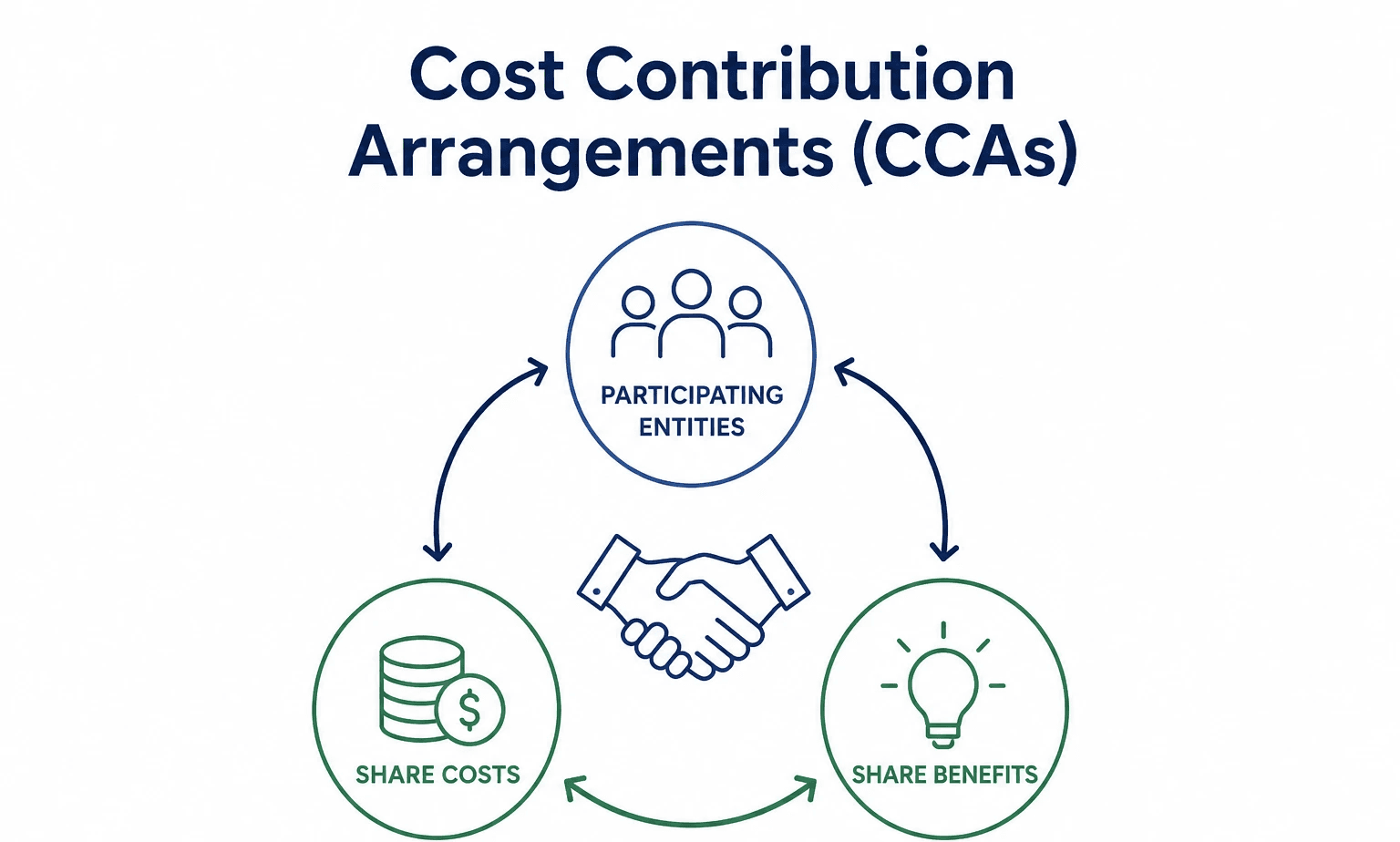
Cost Contribution Arrangements (CCAs) allow group entities to jointly fund the development of an intangible, a service, or another benefit, sharing costs in proportion to their expected benefit rather than paying a royalty or service fee after the fact. Common in R&D-heavy industries such as pharmaceuticals and technology, CCAs are attractive because they align cost-bearing with value creation from the outset. They are also, in the OECD's own words, one of the most audited arrangements in transfer pricing, precisely because getting the mechanics wrong can look indistinguishable from profit shifting.
The Core Design Question: Proportionate Contribution
Under Chapter VIII of the OECD Guidelines, each participant's contribution must be proportionate to its share of the overall expected benefits from the CCA activity, not to an arbitrary allocation key chosen for convenience. Benefit shares are typically projected using metrics such as anticipated sales, units expected to be sold or used, or operating expense ratios, whichever most reliably reflects the actual expected benefit. Because these are forward-looking estimates, CCAs require periodic testing against actual outcomes, and a persistent divergence between projected and actual benefit shares is itself a red flag for tax authorities.
Buy-in and Buy-out Payments
When a new participant joins a CCA, it must generally make a buy-in payment reflecting the value of existing contributions it is now entitled to exploit, effectively buying into pre-existing intangibles or capabilities the CCA has already generated. Conversely, when a participant exits, it is typically entitled to a buy-out payment from the remaining participants for the value of the interest it is relinquishing. Both events require a defensible valuation, and both are common flashpoints in disputes because valuing an unfinished R&D pipeline or a partially developed platform is inherently uncertain.
Balancing Payments
Where actual contributions diverge from proportionate benefit shares in a given period, balancing payments true up the arrangement, participants who contributed less than their benefit share compensate those who contributed more. Without a mechanism to make and document balancing payments, a CCA can silently drift into an arrangement where one entity is effectively subsidising the R&D of another, which tax authorities will recharacterise as a disguised service or financing transaction.
Documentation Expectations
A defensible CCA file should include the identity of participants and their respective interests, the scope of activity covered, the expected duration, procedures for admission, withdrawal and termination, the benefit-share methodology and underlying projections, and evidence that contributions were actually made in the form and amount described. Contemporaneous documentation is essential; retrofitting a CCA narrative after a benefit-share dispute arises rarely survives audit.
Governance as a Practical Safeguard
Beyond the technical mechanics, CCAs work best when governed by a standing committee with representatives from each participant, meeting at a set cadence to review benefit-share projections against actual outcomes, approve new admissions and withdrawals, and formally record any balancing payment required for the period. Groups that treat the CCA as a static legal document signed once and revisited only at audit time are far more exposed than those that treat it as a living governance process reviewed annually alongside the group's broader financial planning cycle.
Conclusion
A CCA is tested against Chapter VIII on three specific points: whether contributions are proportionate to projected benefit shares, whether buy-in and buy-out payments reflect the value of pre-existing and relinquished contributions, and whether balancing payments have actually been made where projected and actual benefit shares diverged. A CCA file that cannot evidence all three, contemporaneously, is functionally indistinguishable from an unpriced cost-sharing arrangement in an audit.